
| CONTENTS | GLOSSARY | SEARCH DOCUMENTATION |
The Grid Parameters widget is used to specify the grids for each of the independent variables in the calculation (e.g., temperature and density), and the photon energy grid.
Separate independent variable grids may be used for the EOS and opacity calculations by unchecking the Use Same Grid for EOS and Opacity box.
If the Compute Opacity box is unchecked, only the EOS data will be calculated.
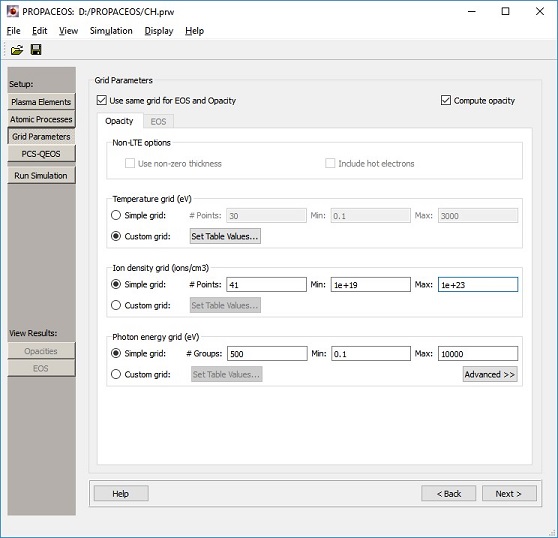
For each variable, there is an option to use either a Simple Grid or Custom Grid:
Note that for the photon energy grid, the number of photon energy groups is specified. There are N(groups) + 1 group boundaries.
Clicking on the Advanced button for the photon energy grid displays further settings:

The values entered here will affect the photon energy grid. The greater the number of points chosen for each transition and for the continuum, the more points will be in the grid. This may lead to a more accurate calculation at the expense of longer CPU time. The value entered in the Add lines with line strength above box affects how many extra photon energies are added to the grid. The line strength parameter takes into account the oscillator strength for the transition and the population of the appropriate energy level.
In a typical PROPACEOS calculations, tables are generated which contain EOS and opacity grids which depend on two independent variables:
Multi-group opacities are generated using the group structure set up in the Photon Energy Grid box.
Additional options for independent variables are available in a Beta version of PROPACEOS. These options are currently only available to a limited user base.
The additional independent variable options are relevant to non-LTE plasma only. The variables are:
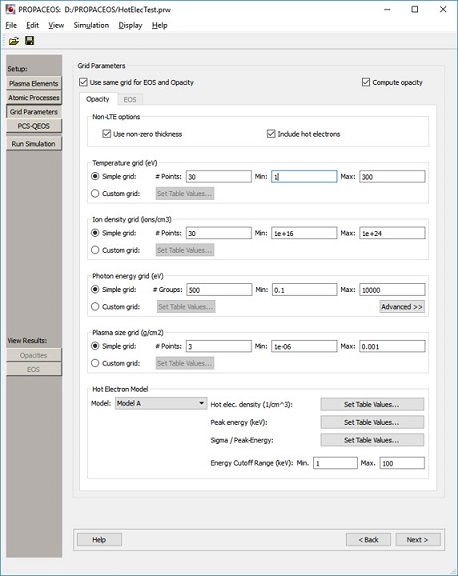
For finite size plasmas, the plasma size is specified in terms of an areal density (ρ ΔL), and the calculation is performed for a planar plasma with thickness ΔL. When these calculations are performed, photoionization and photoexcitation processes are included in the calculation of atomic level populations.
When hot electron modeling is included, the contribution of a non-Maxwellian component to the electron distribution is included when computing atomic level populations. For hot electron modeling, currently one model is supported (Model A). For this case, the hot electron density is modeled using a Gaussian distribution function. Here, the user specifies:
The distribution is normalized such that the total hot electron density is equal to the specified value.
| Copyright © 2024 Prism Computational Sciences, Inc. | PROPACEOS 10.0.0 |