
| CONTENTS | GLOSSARY | SUBJECT INDEX | SEARCH DOCUMENTATION |
Energy can be deposited into the hydro grid by an incident ion beam or electron beam.
The particle beam kinetic energy and power can be specified to vary with time, and also by various kinetic energy (KE) distributions.
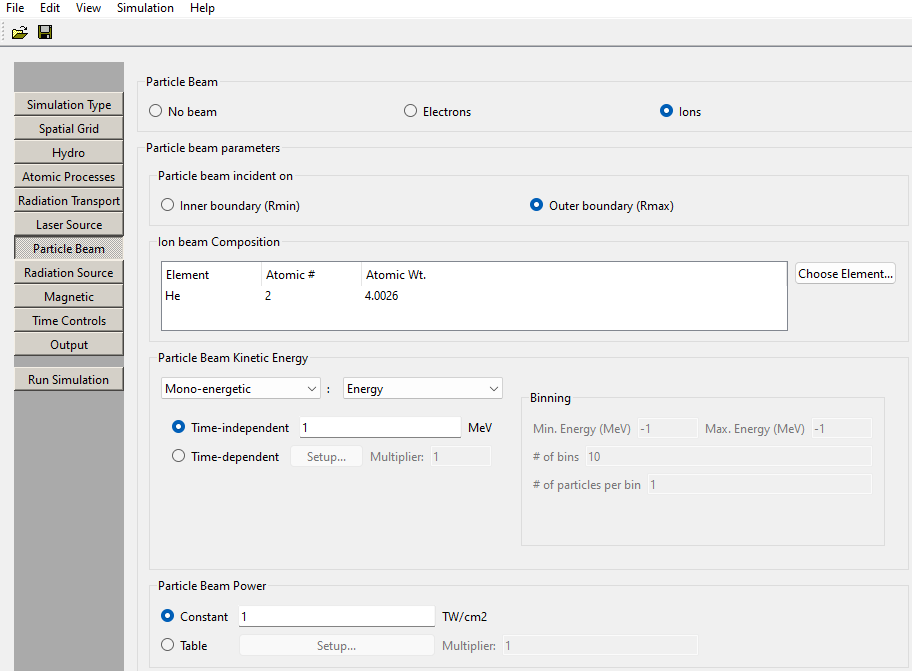
To specify the particle beam parameters:
Normalization: The distributions only define the shape. When running the simulation, Helios will normalize the distributions such that the integral of the distribution, between the Binning Min. and Max. Energy, equals the Particle Beam Power at that time. Note that the times do not need to match. Linear interpolation will be done in the case where time values do not match.
Additionally, if there are hydro times which are before the lowest input time, the value at the lowest input time will be used. Similar treatment will be done for hydro times beyond the highest input time.
Input options:
An example for two times (1 and 2 nsec) is shown below. For each of the 4 beam energies (0.01, 0.1, 1, and 10 MeV), dN/dE is supplied.
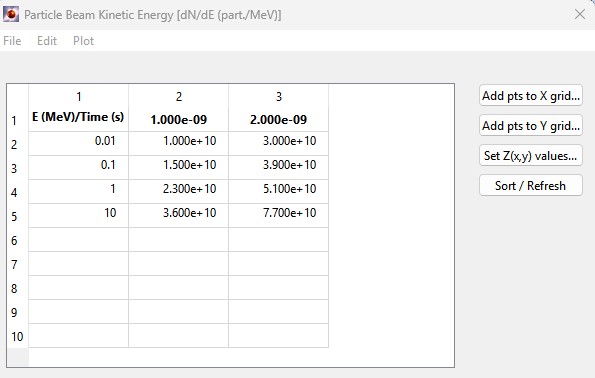
[table format=1]: Tabulated Particle beam KE:
# table rows = 4
# table cols = 3
Energy [MeV]
1.00000e-02 1.00000e-01 1.00000e+00 1.00000e+01
1e-9
1.00000e+10 1.50000e+10 2.30000e+10 3.60000e+10
2e-9
3.00000e+10 3.90000e+10 5.10000e+10 7.70000e+10
Energy binning:
The minimum and maximum energies define the range of the distribution, and should thus be chosen to contain the significant part of the distribution . For example, E0 - 5*sigma to E0 + 5*sigma for a Gaussian, or 0.1*T to 10*T for a Maxwellian.
For Tabular input, the min. and max. should generally match the table range, unless only part of the table is desired. Outside this binning range, the beam power will be zero.
As noted above, the binning min. and max. energies also define the integration region for normalizing the energy distribution to the particle beam power.
The number of particles created per time step will be the number of bins times the number of particles per bin. It is recommended to use 25 - 100 total particles. The number of particles created with energy distributions will be a factor of (# bins x # particles per bin) more than in the mono-energetic beam.
Specify the power by either:
| Copyright © 2002-2025 Prism Computational Sciences, Inc. | HELIOS 11.0.0 |