
External Radiation Sources Setup
An external radiation sources can be applied to the hydro grid
boundaries during a HELIOS simulation. For planar
geometries an external source can be applied at the inner boundary
(R(min)) and/or the outer boundary (R(max)). For cylindrical and
spherical geometries, an external source can only be applied at
the outer boundary.
Models used to specify the flux incident at the boundary are:
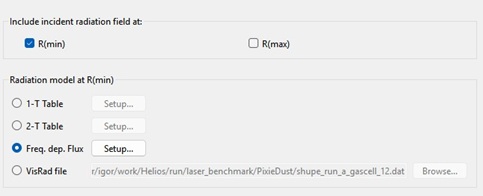
- 1-T Table: A two-column table of times and radiation (or "drive") temperatures. The time dependence of the flux is based on interpolated radiation temperatures from the table. The photon energy dependence is determined assuming a Planckian source with a temperature given by the radiation temperature.
- 2-T Table: A three-column table of times, spectral temperatures, and radiation temperatures. Here, the photon energy dependence is determined assuming a Planckian source with the specified spectral temperature and the total flux is specified using the radiation temperature.
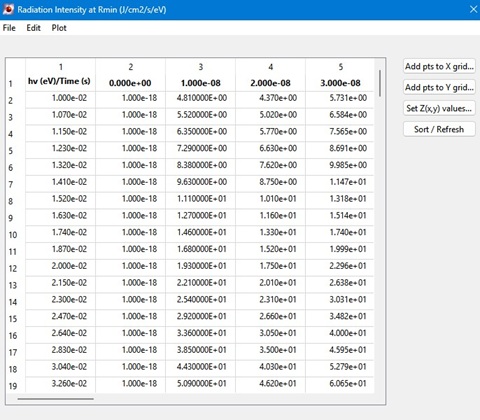
- Frequency-dependent Flux table: A multi-column table of photon-energy- and time-dependent fluxes. Photon energies from the table are automatically remapped to radiation group structure of the simulation.
The time dependence of the flux is based on interpolated radiation fluxes from the table.
- Photon energies are given in the first column (which can be set using the Add Pts to X Grid button).
- Times are specified in the top row, starting in column 2 (which can be set using the Add Pts to Y Grid button). For a radiation flux that is constant in time, only one time column is needed. If the distribution is time-dependent, additional times can be added using the Edit| | Add Column menu item, and entering its time value in the top row of the column.
- Each remaining cell is then the radiation flux (in J/cm2/s/eV) value for that photon energy and time.
- VISRAD
Incident Flux File: A file generated by VISRAD containing
the time- and frequency-dependent incident flux onto a surface.
To specify that an external radiation source is to be applied at
one of the boundaries, check the appropriate box at the top of the
Radiation Source parameters widget.
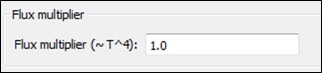
Clicking on the Advanced button allows a flux multiplier to be
specified for the radiation source values:
There is also an option to specify that the
radiation be treated as if it were incident normal to the surface
instead of the usual Lambertian angular dependence. The normal
incidence option is the default when a laser source is used as an
external radiation source. The spectral distribution of the
radiation source can also be treated as being angle dependent
(only if the radiation source is specified using a VISRAD
flux file).

Next
| Copyright
© 2002-2025 Prism Computational Sciences, Inc. |
HELIOS 11.0.0 |