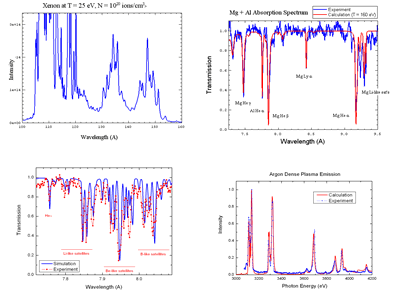
The ATBASE suite of atomic physics codes is used to generate high-quality atomic data for simulating the spectral properties and ionization dynamics of plasmas over a wide range of conditions. It utilizes a suite of atomic structure and modeling codes, including Hartree-Fock, Dirac-Fock, configuration interaction, and distorted wave codes.
ATBASE atomic data has been used extensively in the analysis of spectra from laboratory and astrophysical plasmas. Prism Atomic Data is used in other Prism codes (SPECT3D, PrismSPECT, HELIOS-CR, and PrOpacEOS) to simulate the ionization dynamics and detailed spectral properties of LTE and non-LTE plasmas.
Applications
The ATBASE database has been used extensively in a variety of plasma physics studies, including:- Simulation of spectral properties and ionization dynamics of laser-produced plasmas
- Analysis of spectra of radiatively-heated materials in laser and high-current Z-pinch experiments
- The ionization dynamics and spectral properties of plasmas heated by energetic ions and non-Maxwellian electron distributions
- The formation of inner-shell Kα emission spectra from materials heated by intense ion beams
- The analysis of high-resolution Chandra spectra from high-luminosity stars
- The ionization structure of stellar winds and their radiative properties at UV, EUV, and X-ray wavelengths
Overview of Models
ATBASE generates a comprehensive set of atomic data for all ions of any atomic element. The types of data generated include:
- Atomic energy levels and oscillator strengths
- Photoionization cross-sections
- Electron collisional excitation and ionization cross-sections
- Autoionization rates
- Dielectronic recombination (DR) rate coefficients
Computed using Hartree-Fock and configuration interaction models. When available, experimentally-based energy levels and radiative data are utilized.
Cross-sections from Hartree-Fock calculations are utilized for both valence-shell and inner-shell transitions. Radiative recombination rate coefficients are calculated from the photoionization cross-sections.
Distorted-wave (DW) calculations are performed to generate cross-sections and rate coefficients.
Configuration interaction (CI) calculations are performed to generate autoionization rates.
For dielectronic recombination related to K-shell spectra (Li-like ions and higher), electron capture rates are computed using autoionization rates and the detailed balance relationship. For lower ionization stages, total dielectronic recombination rate coefficients are based on semi-empirical models.
The Flexible Atomic Code (FAC) is an open-source integrated software package that calculates various atomic radiative and collisional processes. Atomic data generated by FAC are already widely used in the HEDLP research community. However, generation and utilization of the data often require substantial expertise in atomic physics. By combining advanced simulation software with open-source atomic structure calculations, Prism developed a new capability that will significantly improve modelling efforts for a wide range of plasma applications. Using FAC data is highly desirable not only because of its ability to generate atomic data for high-Z elements, but also because it can be used for supplying an alternative source of data for Prism simulation codes, a valuable feature for code validation.
Applications
FAC-generated data can be used by all simulation tools developed at Prism: radiation-hydrodynamics, imaging and spectroscopy, and EOS and opacity. EOS and opacity tables generated by the application PrOpacEOS can be used not only with Prism simulation software, but also with other hydrodynamics (e.g., FLASH) and the particle-in-cell (e.g., LSP) codes.
Algorithms
The atomic structure calculation in FAC is based on the relativistic configuration interaction with independent particle basis wavefunctions. These basis wavefunctions are derived from a local central potential, which is self-consistently determined to represent electronic screening of the nuclear potential. Relativistic effects are fully taken into account using the Dirac Coulomb Hamiltonian. Higher order QED effects are included with Breit interaction in the zero-energy limit for the exchanged photon and hydrogenic approximations for self-energy and vacuum polarization effects. Continuum processes are treated in the distorted-wave (DW) approximation.
The following algorithms were implemented:- Full support for JJ coupling scheme in addition to existing LS coupling. FAC data are labeled according to its native convention and the level index. For FAC data, all fine-structure levels can be collapsed into configuration-averaged
- Developed full support for atomic data generated by FAC. Selection of FAC data is implemented as an extra option in the Atomic Model Builder to specify FAC input. At present, Prism codes support only binary tables produced by FAC. This is the default option for FAC. Binary files also perform better than ASCII when read in by the simulation codes. Prism does not plan to support ASCII tables. FAC creates separate files for different types of data, e.g., energy levels are stored in one file, and oscillator strengths for transitions in another file. Thus, when selecting FAC input, the user must select corresponding files from their FAC calculation.
FAC stores atomic levels in order of their energy, regardless of their ionization level. Prism code requires energy levels to be grouped into ionization blocks, and energy-ordered within those blocks. Thus, an index mapping was needed for re-ordering the energy levels after reading from FAC output. In addition, FAC generally calculates atomic data for individual ions in separate processes, as the central potential used to produce the basis wavefunctions needs to be optimized for different ions. The FAC data files for different ionization stages of the same element are combined to produce a single file per process (e.g., energy levels of all ions are combined into one file, and so are those for radiative transitions, collisional excitations, ionizations, etc.).
The latest version 1.5.0 of FAC on github.com/flexible-atomic-code includes newly developed tools to prepare all the aforementioned data files needed to work with Prism software. Input scripts to streamline this workflow have also been developed and may be obtained by contacting Prism directly.
All Prism applications share the same reads for the atomic data and access the atomic databases through light-weight atomic model files (*.atm) generated by the Atomic Model Builder. Once the atomic model files are produced, the source of the underlying data (ATBASE or FAC) becomes completely transparent to the users.